

 Fishician®
Moving or upgrading: protect the biofilter and water conditions
What keeps a tank stable lives on surfaces, not in the water. Protect the media; the old water matters least.
About this guide
On this page
The short answer
- The bacteria live on surfaces. Most nitrifying capacity is on filter media, substrate and rock; old water alone does not carry a working biofilter.
- Keep media wet and oxygenated. That's the top priority. Old water is the lowest.
- Never move a tank with anything in it. Water, substrate or rock can crack seams. Lift from the base.
- An upgrade is a stocking event. The biofilter didn't grow just because the tank did.
- Test for days afterwards and hold off on new fish until readings are stable.
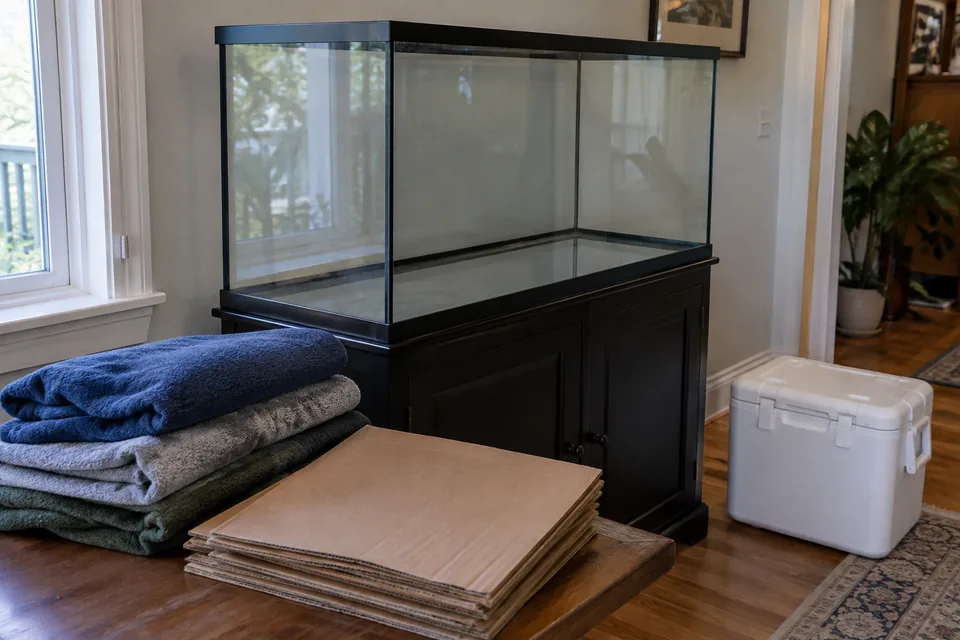
The order of a move
- Prepare the destinationStand, power, matched water
- Catch fish firstInto covered, matched holding tubs
- Keep media wetAnd aerated if possible
- Drain and moveEmpty, lifted from the base
- Rebuild and refillStable rock, prepared water
- Restart, then fishFlow first; correct heater water level
Never
- Chase fish around a nearly drained tank full of rock.
- Lift a tank by the rim or frame.
- Switch on a heater outside its manufacturer’s permitted water level.
- Add new fish on moving day.
Upgrading to a bigger tank
- Carry over as much mature surface as the layout allows, above all the filter media.
- Running the old filter alongside the new one for a while carries capacity across.
- Match new water chemistry to what the fish know. See source water.
After rebuilding
- A new layout can remove the visual breaks that kept rivals apart. Watch for new aggression. See hardscape.
- Disturbed substrate can cause haze; check water quality and fish before assuming it is harmless. See cloudy water.
- Check for leaks before fish go back. Reintroduce with care; see acclimation.
- Low light, light feeding, and log the date of the move.
Long moves
- Plan secure transport containers, oxygen supply and temperature control. Any pre-transport fasting depends on the species and life stage.
- Media sealed without oxygen deteriorates. Treat the tank as only partly cycled at the other end.
Why old water matters least
- Tank water holds comparatively little of the nitrifying bacteria.
- Hauling it is heavy and awkward, and takes effort away from protecting the media.
- Aim for new water that's close in chemistry to the old, not for the old water itself.
- Use prepared, conditioned, temperature-matched water to refill.
Sources
Each source is listed with the part of this guide it supports.
- Merck Veterinary Manual: Management of Aquarium FishBiofilter establishment and protection, gradual stocking, and monitoring after a disruptive change.
- University of Florida IFAS: Fish Fingerlings — Purchasing, Transporting, and StockingTransport stress, water quality inside a transport container, and re-introduction after a move.
- University of Florida IFAS: Fish Health Management in Recirculating Systems, Part 1Where nitrifying capacity actually lives in a system, and what preserves it when components are disturbed.