

 Fishician®
Source water: the input you did not choose but still have to manage
Every water change and top-off pours something into the tank, and it can change without notice. Know what's in it.
About this guide
On this page
The short answer
- Tap water changes. Treatment varies by season and maintenance. A problem right after a water change points at the new water first.
- Chloramine doesn't gas off. Unlike chlorine, it stays. Use a conditioner that says it handles chloramine.
- Both harm the filter bacteria. Never rinse filter media under untreated tap water.
- Softened water is not purified water. Many household softeners replace calcium and magnesium with sodium or potassium; they do not remove all dissolved substances.
- Prepare purified water for its purpose. New freshwater usually needs suitable minerals; marine water needs salt mix. Evaporation top-offs generally need neither.

Four kinds of source water
City: chlorine
- Leaves standing, agitated water over time
- Still use a conditioner
City: chloramine
- Stable; doesn't gas off
- Breaking it releases ammonia
Well
- Can carry gases, iron, sulfide or nitrate
- Test before relying on it
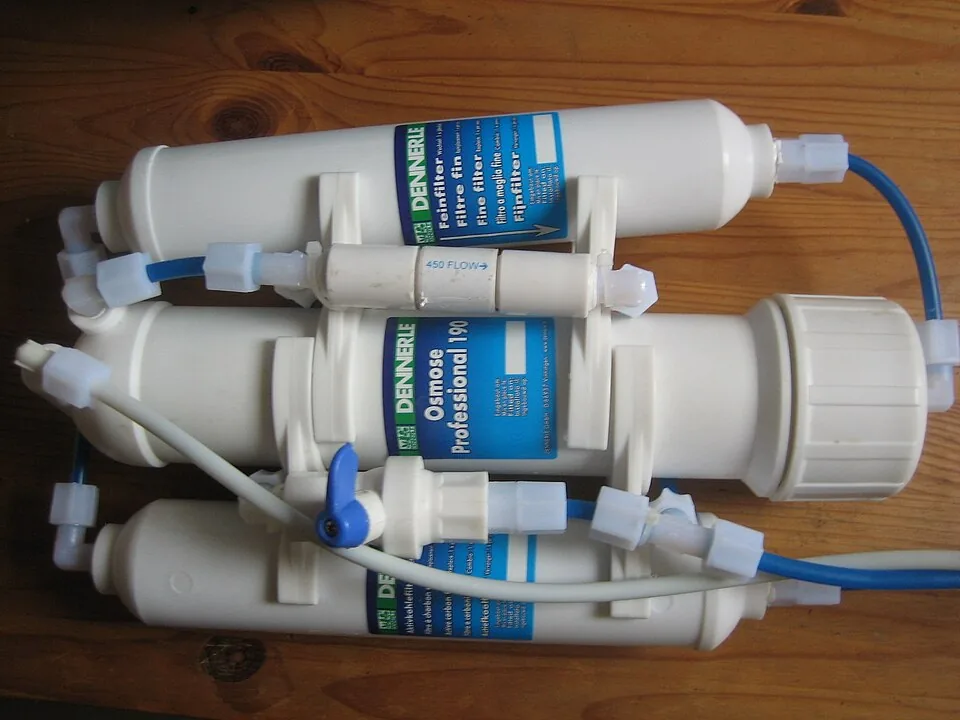
RO / DI
- A blank slate
- Prepare for a water change; top-offs differ
- Check output on a schedule
Know your supply
- Is it chlorinated or chloraminated? What are its hardness, alkalinity and nitrate?
- Read your utility's published water-quality report; it tells you more than one home test.
- Very low alkalinity means little buffering, one reason pH drifts down between changes.
- Nitrate or phosphate in the supply feeds algae with every change.
Draw it right
- Use a cold line run briefly first; standing pipe water can pick up metals.
- Never use hot-water lines. Heat the water separately.
Prepare it in a bucket, not the tank
- Condition, following the current label for your exact product.
- Marine: dissolve salt fully and measure salinity with maintained equipment.
- Match temperature and chemistry to the tank.
- Catch mistakes while they only affect a bucket.
Top-off vs water change
- Evaporation leaves salt and most minerals behind. RO/DI water is commonly used for top-offs without adding salt or remineralizer.
- A water change replaces both. Mixing them up slowly shifts salinity and hardness. See water changes.
Re-check when
- An unexplained problem follows a water change.
- The utility does maintenance, the season changes, or well conditions change.
- Purification membranes or resin are due for service; they fade gradually, not visibly.
When purified water helps
- Your tap water is unsuitable for the fish you keep.
- You need chemistry the tap can't provide.
- A marine or specialized system needs control over what goes in.
- For water changes, match the required mineral content or mix marine salt according to the product instructions. Do not apply that recipe to evaporation top-offs.
Sources
Each source is listed with the part of this guide it supports.
- Seachem Support: Remineralization and Top-Off WaterManufacturer support distinguishes replacing evaporated water from remineralizing replacement water; top-offs do not automatically need additional minerals.
- Merck Veterinary Manual: Management of Aquarium FishSource-water preparation, dechlorination, and the water-quality checks that precede adding water to a stocked aquarium.
- University of Florida IFAS: Fish Health Management in Recirculating Systems, Part 1Source-water risks in a closed system, and why incoming water is treated as a variable rather than a constant.
- University of Florida IFAS: Ammonia in Aquatic SystemsChloramine as a combined chlorine-ammonia compound, and how alkalinity and pH shape the chemistry of incoming water.