 Fishician®
Starting a saltwater aquarium
Saltwater asks for more patience, more equipment, and more precise measurement than freshwater. None of that is a reason to avoid it — it is the actual shape of the commitment.
Decide what kind of saltwater tank you're building
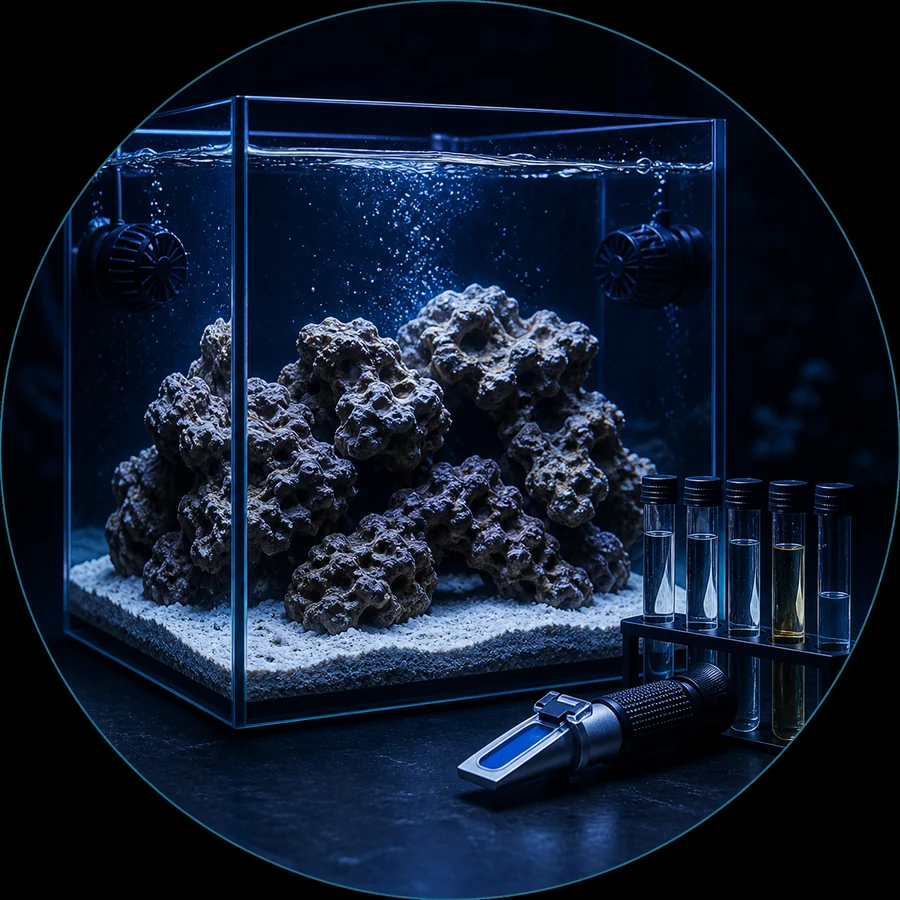
Fish-only, fish-only-with-live-rock (FOWLR), and reef systems have real differences in cost, equipment, lighting, and how much precision the routine requires. A reef intended to keep light-demanding coral has a lower tolerance for parameter swings than a fish-only system. Decide the category before buying equipment, since lighting and filtration choices differ meaningfully between them — see the reef tank basics guide for the live rock, salinity, and skimmer fundamentals shared across all three.
Budget for the whole system, not just the tank
Saltwater setups typically cost more than an equivalent-size freshwater tank once salt mix, a refractometer, a protein skimmer, live rock or sand, and marine-appropriate lighting and filtration are accounted for. Underbuying any one of these — especially filtration and skimming capacity relative to planned stocking — tends to show up later as a harder-to-solve water-quality problem rather than saving money overall.
Mix and measure before anything touches the tank
Mix synthetic sea salt into dechlorinated freshwater with circulation until it is fully dissolved, then measure salinity with a calibrated refractometer rather than estimating by scoop count — the reef tank basics guide covers why measurement matters and how to avoid a false early reading. Match temperature and salinity to the display tank before any water transfer, whether that is initial fill or a routine change.
Cycle patiently, with real verification
Whether you seed the system with live rock, a bottled bacterial product, a controlled ammonia source, or some combination, verify readiness with ammonia and nitrite testing exactly as described in the cycling and water testing guide — a marine biofilter is not automatically faster or slower than a freshwater one, and a calendar date is not proof either way. Run the skimmer and full circulation during this period even with no fish present.
Stock slowly and quarantine seriously
Add hardy, well-researched species first, one addition at a time, with testing after each one. Many common marine treatments — including copper-based medications — are lethal to invertebrates and can be difficult to remove from a display system once introduced, which makes a genuine quarantine setup more valuable in saltwater than almost anywhere else in the hobby: it keeps a treatment option available without risking the display.
Expect a longer runway than freshwater
Marine systems commonly take longer to stabilize before they are ready for sensitive livestock, and rushing that stabilization — adding coral or delicate fish before parameters have held steady for a meaningful period — is one of the more common ways a new reef tank runs into trouble. Consistent testing, a maintained record, and resisting the urge to add "just one more thing" while things still look unsettled will do more for a new saltwater tank than any single piece of equipment.
Sources and further reading
Each source is listed with the part of this guide it supports. Source scope matters: a taxonomy record, product label, or general husbandry page does not automatically support every care claim.
- Merck Veterinary Manual: Providing a Home for Fish
Water preparation, filtration, and environmental setup considerations that apply to marine systems. - Merck Veterinary Manual: Management of Aquarium Fish
Cycling, gradual stocking, quarantine, and water-quality monitoring relevant to a new marine system. - University of Florida IFAS: Dissolved Oxygen for Fish Production
Temperature and salinity effects on dissolved oxygen, relevant to marine system stability.