 Fishician®
Reef tank basics: live rock, salinity, and protein skimming
Three things separate a reef system from a freshwater one at the mechanical level: what seeds the biofilter, how precisely you measure the water itself, and how waste leaves the system before it ever becomes nitrate.
Live rock does two jobs at once
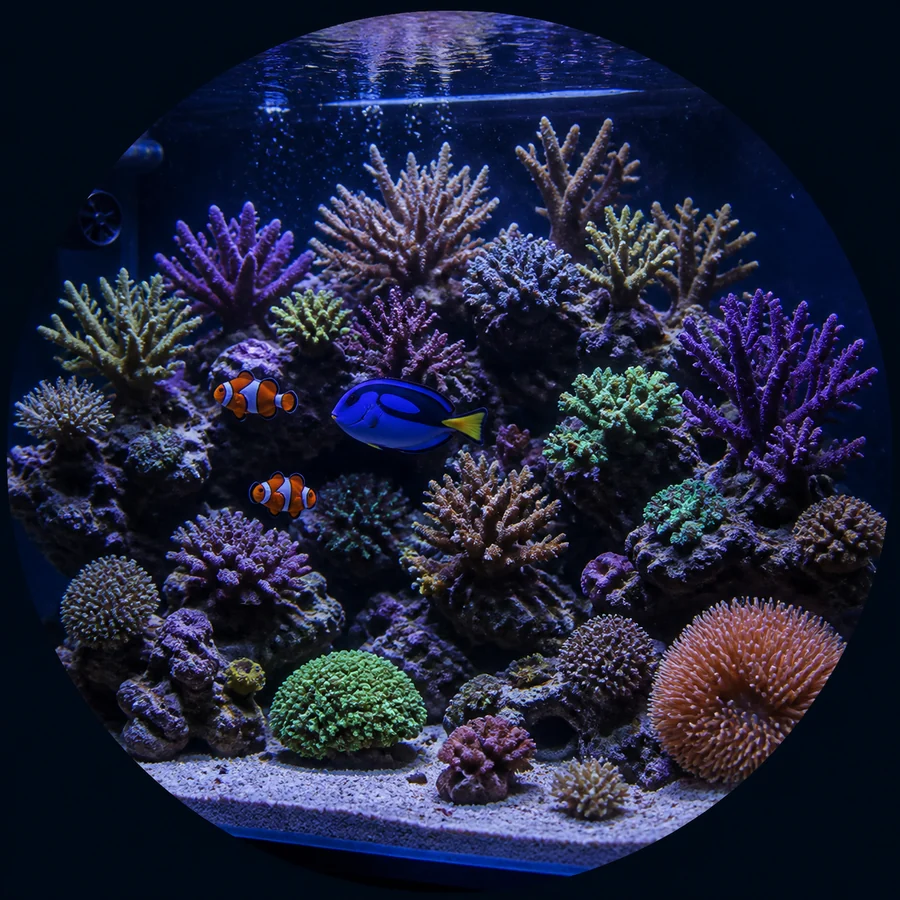
Live rock — reef structure carrying an established population of nitrifying bacteria and, often, other marine organisms — provides both the aquascape and a large share of the biological filtration in many marine systems, the same role filter media plays in a freshwater tank. Rock sold as "cured" has already passed through its own die-off and stabilization period; "uncured" rock is fresher and typically carries more life, but it also carries more organic material that will decompose and drive an ammonia and nitrite spike as the system establishes.
If you add uncured rock, treat that period exactly like a fishless cycle: monitor ammonia and nitrite, keep circulation and any skimmer running, and do not add fish until the same testing standard described in the cycling and water testing guide is met. Rinsing rock in premixed saltwater rather than tap water before placement reduces how much loose debris enters the display.
Salinity is a measurement, not a scoop count
Salinity affects osmoregulation, oxygen solubility, and the biology of every animal and photosynthetic organism in the tank, and it needs to be measured, not estimated. A calibrated refractometer is the standard tool; a swing-arm hydrometer is cheaper but drifts with age and residue and is more prone to reading error. Whichever tool you use, calibrate or check it against a reference solution periodically rather than trusting it indefinitely.
Mix synthetic sea salt into premixed water fully — ideally with circulation and enough time for the salt to dissolve completely and the temperature to stabilize — before measuring and before that water goes anywhere near the display tank. Measuring a batch too early, while salt is still dissolving, gives a false reading. As in the water changes guide, match temperature and salinity to the display tank before any water transfer, and treat topping off for evaporation and an actual water change as two separate tasks — evaporation removes only water and leaves salt behind, so replacing it with more saltwater will raise salinity rather than correct it.
What a protein skimmer is actually removing
A protein skimmer works by mixing air into water inside a reaction chamber; dissolved organic compounds — proteins, waste, and other surfactant-type material — collect on the surface of the resulting bubbles and rise out of the water as foam, which is physically exported in the collection cup. This removes that organic load before it ever reaches the biofilter and becomes nitrate, which is why a well-run skimmer tends to reduce the water-change burden without eliminating the need for them.
A new skimmer typically needs a break-in period of days to weeks before its foam production and skimmate consistency settle into a predictable pattern — early output is often thin, wet, or inconsistent while the unit and the water's organic load find their balance. Empty the collection cup on a regular schedule rather than letting it overflow back into the sump, and rinse it periodically so dried residue does not restrict foam flow.
A skimmer is a supplement to biological filtration and water changes, not a replacement for either. Systems running very low bioload — for example a lightly stocked, heavily planted refugium-supported tank — may run productively with a smaller skimmer or none at all, while a heavily stocked reef generally benefits from one sized to the actual load rather than to the tank's nominal volume.
Lighting for a photosynthetic tank
Corals, anemones, and other photosynthetic invertebrates host symbiotic algae that need light in a specific intensity and spectrum range, and requirements vary meaningfully between species and depth of origin. A fish-only-with-live-rock system has far more lighting latitude than a system intended to keep light-demanding coral, so decide which category you are building toward before buying lighting equipment, and research the specific requirements of any coral you intend to keep rather than assuming one fixture setting suits everything in the tank.
Build in this order
Cycle the system — with live rock, a controlled ammonia source, or both — and verify with testing before livestock. Establish stable salinity, temperature, and flow. Add hardy, undemanding livestock first and quarantine new arrivals before they join the display. Add light-demanding or sensitive species only once water parameters have been stable for a meaningful stretch, not on a fixed calendar date.
Live rock
Biological filtration and aquascape together. Uncured rock needs its own cycle before livestock.
Salinity
Measure with calibrated equipment. Match it before any water enters the display, and treat top-off and water changes separately.
Skimmer
Exports dissolved organics as foam before they become nitrate. Expect a break-in period; empty the cup regularly.
Sources and further reading
Each source is listed with the part of this guide it supports. Source scope matters: a taxonomy record, product label, or general husbandry page does not automatically support every care claim.
- Merck Veterinary Manual: Providing a Home for Fish
Aquarium environment, filtration purpose, and water-preparation fundamentals that apply to marine systems. - Merck Veterinary Manual: Management of Aquarium Fish
Water-quality monitoring, biofiltration, and management practices relevant to marine as well as freshwater systems. - University of Florida IFAS: Dissolved Oxygen for Fish Production
How temperature and salinity affect dissolved-oxygen solubility, relevant to aeration and gas exchange in marine systems.