

 Fishician®
Aquarium lighting: intensity, spectrum, and day length are three separate decisions
Light serves you, the plants and the algae at once. Decide who it's for before you buy.
About this guide
On this page
The short answer
- Fish-only tanks light for viewing. Fish need a steady day-night cycle and shade, not intensity.
- Plants and coral use light as energy, but only with carbon and nutrients to match. Extra light alone often grows algae.
- Three separate dials: intensity, spectrum and duration. They aren't interchangeable.
- Oxygen swings with the light. In planted or algae-rich tanks, oxygen often rises during light and falls overnight. Aeration and other factors also matter.
- A timer beats a fancy fixture. Consistency is what fish and plants respond to.
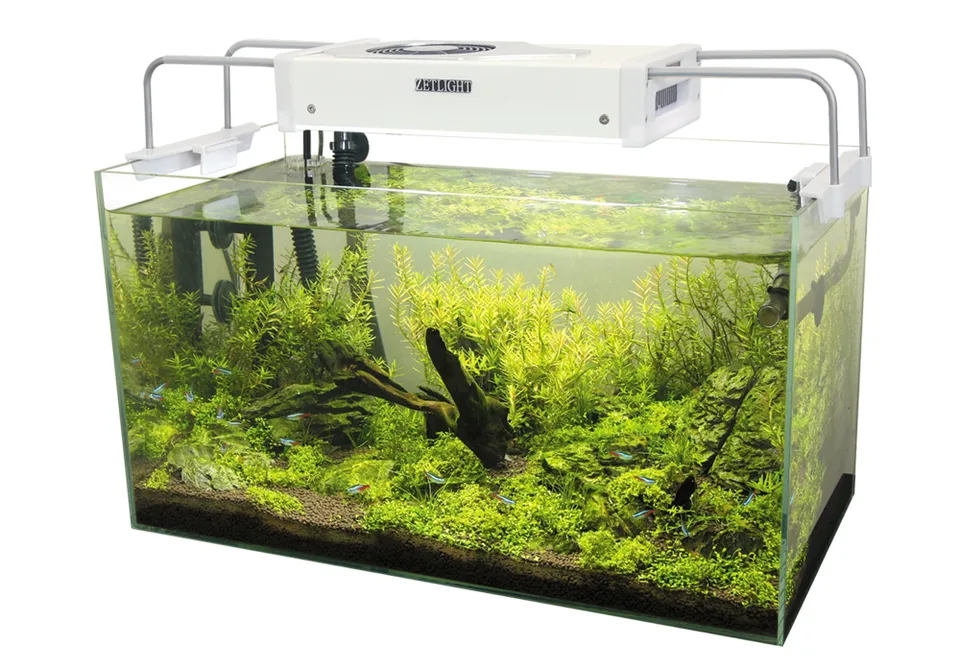

The three lighting dials
Intensity
- Energy reaching a point
- Falls with depth and haze
- A rating means little without its depth
Spectrum
- Which wavelengths
- Box names aren't standard
- Trust published spectral data
Duration
- Hours on per day
- Cheapest to change
- Change one way, then wait
Before buying a fixture
- Know the tank's depth and footprint, and what in it is photosynthetic.
- Check published output and spectral data, mounting distance and ventilation.
- Plan how it will be controlled: timer or controller.
Changing the photoperiod
- There's no universal right number of hours.
- Change duration in one direction, note the date, and hold it long enough to see the effect on plants, algae and fish.
- Light is only one algae input. Cutting it doesn't remove built-up nutrients and can starve your plants.
Signs light is part of a problem
- Algae speeding up on lit surfaces.
- Plants thinning despite enough light (often missing carbon or nutrients).
- Fish breathing hard at the surface early in the morning. Add surface movement. See aeration.
- Temperature rising with the lighting schedule.
Sunlight and safety
- Window light is an uncontrolled extra photoperiod that also adds heat. Move or shade the tank.
- Drip loops on cords, connections above the water line, and fixtures rated for the humidity.
Who the light is for
- Fish only: the lowest intensity that shows the fish clearly, plus shaded cover.
- Planted: light matched to the carbon and nutrients available.
- Reef: intensity and spectrum matched to the corals you keep.
- A fixture chosen for one of these is often wrong for another.
- Record every change to a lighting setting with its date.
Sources
Each source is listed with the part of this guide it supports.
- University of Florida IFAS: Dissolved Oxygen — Plant Management in Florida WatersHow illuminated photosynthesis and continuous respiration drive daily dissolved-oxygen swings in a planted body of water.
- Merck Veterinary Manual: Providing a Home for FishLighting as part of the aquarium environment, along with placement, cover, and general equipment setup.
- University of Florida IFAS: Dissolved Oxygen for Fish ProductionPhotosynthesis and respiration drive oxygen changes; oxygen is often lowest before dawn in systems with substantial photosynthetic biomass.