 Fishician®
Aquarium temperature: stability over targets
Fish are ectotherms — water temperature sets their metabolic rate. It also sets how much oxygen the water can hold, and how toxic a given ammonia reading is.
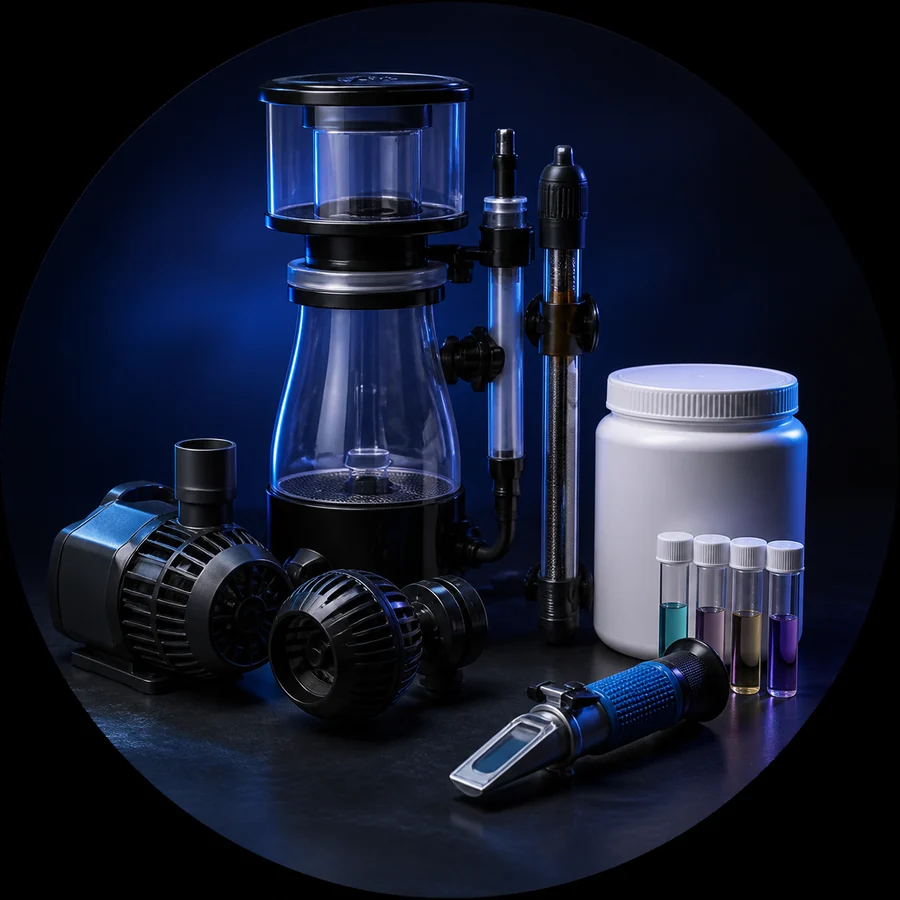
Temperature is not an isolated setting
Because fish do not regulate their own body temperature, water temperature directly drives metabolic rate, oxygen demand, digestion, growth, immune function, and the progression of disease. Raising temperature raises the animals' oxygen requirement while simultaneously reducing how much dissolved oxygen the water can hold. Those two effects move in opposite directions, which is why heat events are dangerous well before the temperature itself becomes lethal.
Temperature also changes water chemistry. The proportion of total ammonia present as the highly toxic un-ionized form rises with temperature as well as with pH, so the same ammonia test result is more dangerous in a warm tank. Reading temperature alongside your other parameters is not optional.
Stability usually beats precision
An appropriate, steady temperature is generally safer than repeated adjustment toward an exact number. Rapid swings are a stressor in their own right, and stress suppresses immune function. The species you keep define the appropriate range; keeping the system reliably inside it matters more than which decimal you land on.
Where a stocking plan requires two species with genuinely incompatible temperature ranges, the answer is a different stocking plan — not a compromise temperature that suits neither. Check the requirements of every resident together, as part of the compatibility work, rather than species by species.
Choosing and placing a heater
- Size to the job, not just the tank. The work a heater must do depends on room temperature and how far the water sits above it, plus the aquarium's volume and how much surface it loses heat through. A cool room demands more capacity than a warm one.
- Consider splitting the load. Two smaller heaters in a larger aquarium mean a single failure is less likely to be catastrophic in either direction: one heater stuck off cannot chill the tank alone, and one stuck on has less capacity to overheat it.
- Place it in flow. A heater in a dead zone heats its immediate surroundings and lets the thermostat cycle against a temperature the rest of the tank never sees. Position it where circulation carries heat away from it.
- Follow the manufacturer's instructions for submersion depth, orientation, and whether the unit may run out of water. Many failures come from running a heater dry during a water change.
- Wire it safely. Use drip loops, keep connections dry and above the water line, and follow local electrical practice for a wet environment.
Measure independently and verify
A heater's dial is a control setting, not a measurement. Verify actual water temperature with a separate, maintained thermometer, and check it as part of daily observation. A second thermometer at a different point in the tank will reveal stratification and poor circulation.
Match the temperature of replacement water before it enters the aquarium, and measure it rather than judging by hand. This is one of the most common sources of an avoidable temperature swing.
Plan for heat and for power loss
Overheating is usually harder to fix than underheating. Warm-weather risks include room temperature, direct sunlight on the aquarium, and heat from lighting and pumps. Practical responses include increasing surface agitation and gas exchange, improving room ventilation, reducing lighting hours, and increasing circulation — with the priority being oxygen availability, since that is what limits the animals first.
During a power failure, an insulated aquarium loses heat slowly, but it also loses circulation and gas exchange immediately. Surface agitation is generally the more urgent concern; large aquariums have significant thermal inertia. Avoid large corrective swings when power returns, and check equipment restarted correctly before assuming normal operation.
Log temperature with your other observations. A slow drift over weeks — a heater weakening, a room warming with the season — is invisible day to day and obvious in a record.
Sources and further reading
Each source is listed with the part of this guide it supports. Source scope matters: a taxonomy record, product label, or general husbandry page does not automatically support every care claim.
- University of Florida IFAS: Dissolved Oxygen for Fish Production
Temperature and salinity control oxygen solubility while metabolic oxygen demand rises with temperature. - Merck Veterinary Manual: Providing a Home for Fish
Heating and environmental control for the aquarium, equipment placement, and electrical safety. - Merck Veterinary Manual: Management of Aquarium Fish
Temperature as a management variable, stress from unstable conditions, and equipment monitoring.