

 Fishician®
Reading aquarium equipment specifications without being misled
Equipment labels summarize selected test conditions. Compare those conditions with your aquarium before choosing a model.
About this guide
On this page
The short answer
- Volume ratings are a starting point. Check the manufacturer's assumptions and limits. Stocking, feeding and maintenance affect the load.
- Check how flow was measured. Test conditions vary. Lift, hose, fittings and media can reduce flow in your installation.
- Flow isn't filtration capacity. Media, oxygen, waste load and maintenance also matter; pump speed alone does not establish biological capacity.
- Heater wattage depends on the room. A cold garage needs more than a warm living room.
- Light wattage is power used, not light delivered. Output needs the depth it was measured at.
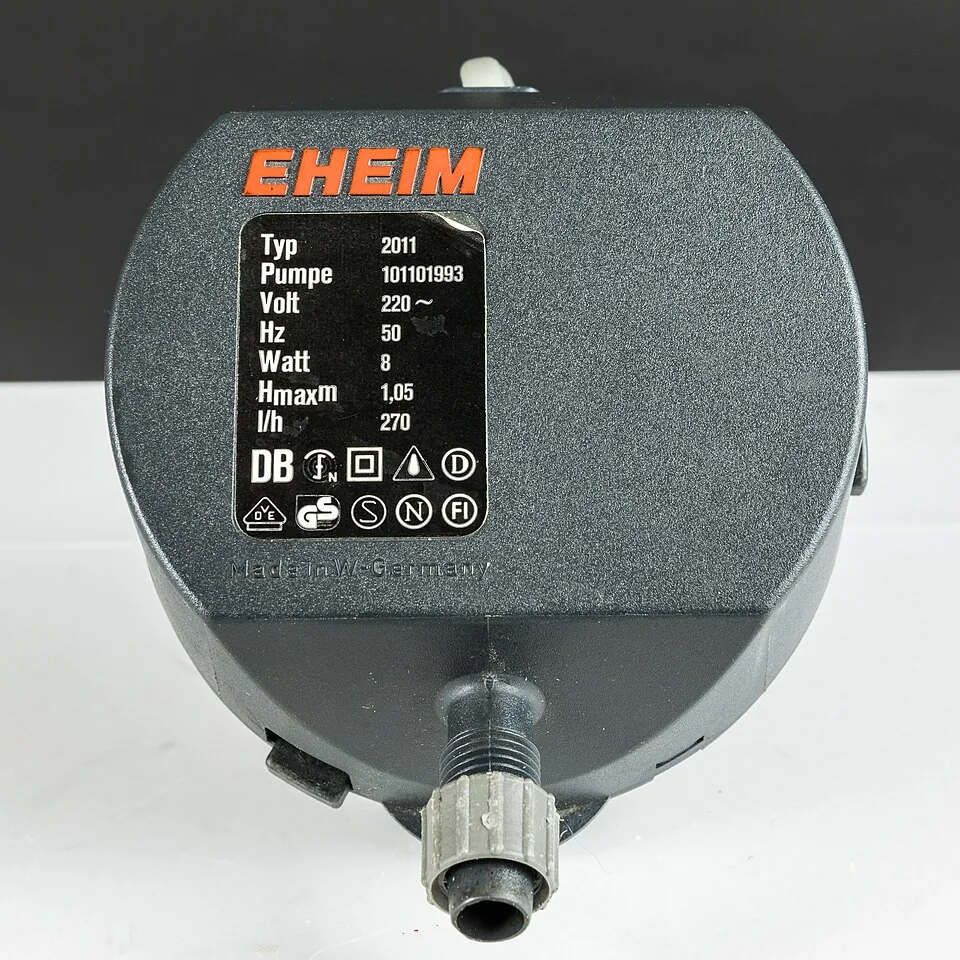

- Wattage
- Dimensions and hose sizes
- Published spectral data
- Light output at a stated depth
- "Rated for up to N gallons"
- Flow at zero head with no media
- Spectrum names on the box
- A heater's own display as temperature
Read one actual specification in context
The EHEIM thermocontrol 100 page identifies model 3614010, 100 W, and an approximate aquarium range of 100–150 litres. That is a manufacturer rating, not proof it will hold your target in your room. Its adjustment range describes the device, not the temperature your fish need.
Copy a comparison row: Exact model ___; region/voltage ___; physical fit ___; installation limits ___; aquarium conditions assumed ___; replacement parts ___; manual/source ___; unanswered questions ___. Check each candidate against the same installation. Do not apply one model's depth or operating instructions to another.
Filters and pumps
- Judge against your own stocking and feeding, not the assumed ones.
- Check the media baskets can be serviced without dismantling everything, and that parts are available.
- Make sure outflow can be aimed to move the surface, which drives gas exchange. More in filtration.
Heaters
- Many thermostats hold a band, not an exact value.
- Verify with an independent thermometer, and check that thermometer now and then.
- Appropriately sized, independently controlled heaters can reduce some failure risks, but do not guarantee temperature control. See temperature.
Lighting
- LED wattage can't be compared with older technology.
- Spectrum names aren't standard; the published data is the real claim.
- Match light to the chosen plants or corals and their other requirements; brightness alone does not establish suitability. See lighting.
Specs hiding in the manual
- Water-depth limits, clearance and ventilation, hose diameter, rim thickness for clip-ons.
- Whether it's rated for saltwater at all.
- Electrical needs: drip loops, dry connections above the water line, humidity rating.
Tank-size ratings in practice
- Two tanks of the same volume can load one filter very differently: stocking, feeding, warmth and debris all change it.
- Use the rating as a rough bracket, then look at the measured numbers.
- Check replacement media and impellers are available before you buy.
- Judge equipment against your own stocking plan and habits.
Sources
Each source is listed with the part of this guide it supports.
- EHEIM: thermocontrol 100Model 3614010 example: 100 W and approximate 100–150 litre rating; published adjustment range is an equipment capability, not a species temperature recommendation. No fit or performance verification is claimed.
- Merck Veterinary Manual: Providing a Home for FishAquarium environmental setup, equipment and filtration context.
- Tropica: LightPlant-specific light requirements; electrical consumption is distinct from illumination at the leaves.