

 Fishician®
Getting a water test result you can actually trust
Use the instructions for your exact kit: measure the sample, add and mix reagents as directed, then read at the specified time. A useful result also records the unit and what the test actually measures.
About this guide
On this page
The short answer
- Check expiry and storage. Expired or poorly stored reagents can give inaccurate results. Replace them according to the manufacturer’s instructions.
- Fill to the line. Test kits are ratio chemistry; eyeballing the sample changes the result.
- Follow the exact test method. Sample size, mixing and reading times vary between kits. Do not transfer instructions from another brand.
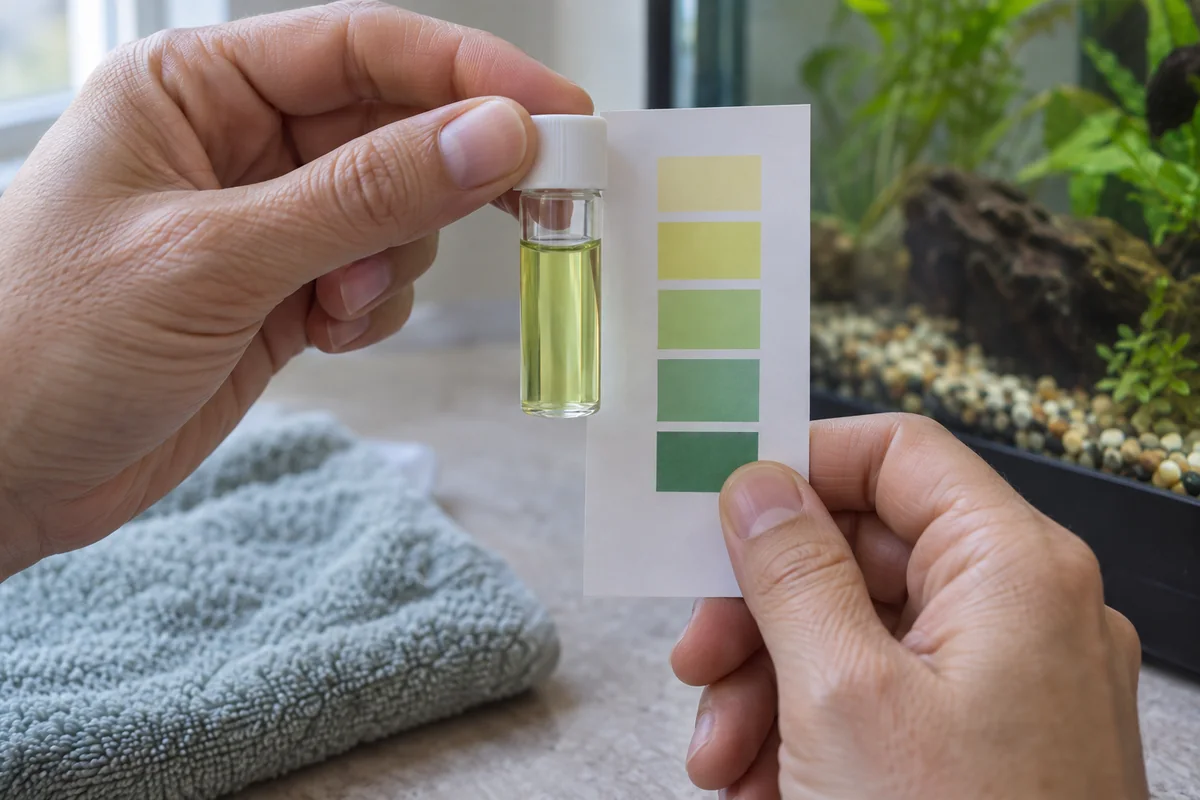
- Read colour as instructed. Use the supplied chart and recommended lighting. A borderline colour is not a precise number.
- Record what was measured. Note the kit, unit and whether ammonia means total ammonia or free NH3, and whether it is reported as nitrogen.
- Check expiry and storage
- Clean the vial as instructed
- Measure the specified sample
- Hold the bottle as instructed
- Follow shake and wait times
- No reagent carried between tests
- Use the specified light and chart
- Check unexpected results
- Log value, unit, date and kit
Before you start
Check that the kit covers your water type, the substance you need to measure and the expected range. A multi-test pack does not necessarily include every test you need.
Check expiry, storage directions and any limit after opening. Keep caps and droppers with their own bottles. Heat, moisture and contamination can affect reagents before the printed expiry date.
Run the test in order
- Prepare the vial. Follow its cleaning directions; some specify distilled or deionized water. Avoid leftover rinse water diluting the sample.
- Measure the sample. Use the specified volume from representative, well-mixed tank water, away from newly added chemicals.
- Add and mix. Follow the stated reagent order, bottle position and mixing times. Use the vial cap; do not substitute a finger over the opening.
- Time the reading. Use a timer. Match the supplied chart in the lighting and viewing position the manufacturer specifies.
- Record and clean up. Note the value, unit, date and kit. Dispose of the tested sample as directed, never back into the tank, and rinse the vial promptly.
Using strips? Follow their dipping and reading instructions instead. Different pads may need different reading times; a liquid kit's method does not apply.
An unexpected result: what next?
Repeat with a fresh sample and check the method. A borderline colour is not a precise number. Compare with another suitable, unexpired kit or an independent water test if the result remains uncertain.
Testing tap water checks the supply, not the kit's accuracy. Tap water is not a reference standard. Where available, use a known reference solution approved for that test and range.
With fish present, detectable ammonia or nitrite needs prompt investigation. A low or zero result does not rule out every water-quality problem.
Compare like with like
Record conditioner or treatment use: some products interfere with particular test methods. Check both sets of instructions. Keep the kit name in your log so a brand switch is visible.
Why two ammonia results may differ
Check whether each test reports total ammonia or free NH3, and whether its units express nitrogen or the whole compound. Those values are not interchangeable. The toxic share of total ammonia rises with pH and temperature; see water parameters before comparing risk.
Sources
Each source is listed with the part of this guide it supports.
- Hanna Instruments: Marine Checker Best PracticesExpired reagents can give inaccurate readings; reagent storage, clean cuvettes and method-specific handling affect results.
- API: Freshwater Master Test KitFollow each individual test's booklet directions, secure the vial cap during mixing and rinse promptly after testing; the kit lists exactly which measurements it contains.
- Tetra: Test pH InstructionsA model-specific example of measured sample volume, reagent-bottle orientation, capped mixing and a specified chart viewing position; its drop count is not a universal test procedure.
- API: Freshwater/Saltwater Nitrite Test Solution Safety Data SheetReagent handling and disposal precautions; tested samples contain chemicals and should not be returned to the aquarium.
- API: 5-in-1 Test Strip InstructionsDifferent pads have different reading times; storage and handling directions are specific to the test.
- Hach: DR 5000 Procedures ManualAccuracy checks use a known standard appropriate to the analyte and method, rather than an unknown tap-water sample.
- University of Florida IFAS: Ammonia in Aquatic SystemsTotal ammonia nitrogen versus un-ionized ammonia, and how pH and temperature change what a reading means.
- Merck Veterinary Manual: Management of Aquarium FishWater-quality monitoring, test interpretation in context, and common aquarium water-quality failures.
- University of Florida IFAS: Fish Health Management in Recirculating Systems, Part 1Monitoring practice and water-quality parameters in a closed recirculating system.