

 Fishician®
Routine aquarium maintenance and observation
Build the routine around what the tank and its fish show you, and keep enough history to spot change early.
About this guide
On this page
The short answer
- Look before you touch. Check every fish before feeding or maintenance changes how they act.
- Know each fish's normal. Hiding is normal for a nocturnal catfish, a warning for an active daytime fish.
- Let trends set the schedule. Stocking, feeding, plants and filtration decide how often, not a universal calendar.
- Stagger filter cleaning. Never replace every biological surface at once.
- Write things down. Most problems come down to one question: what changed recently?
Three kinds of maintenance
Daily
- Look at every fish
- Check temperature and equipment
- Feed; remove uneaten food
Periodic
- Test water
- Partial water change
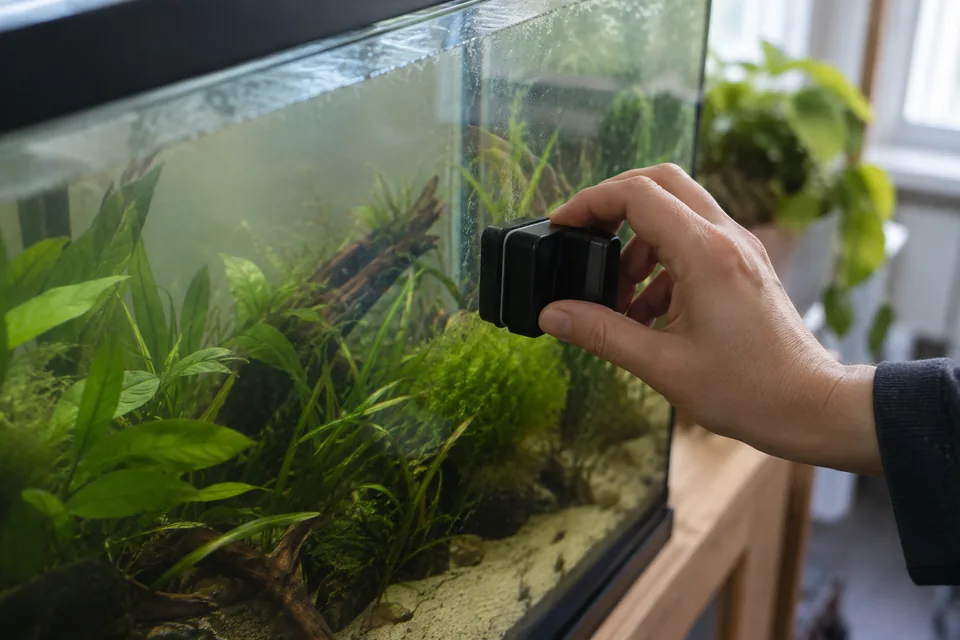
- Clean substrate and glass, trim plants
- Inspect filter
After an event
- New fish or plants
- Medication or equipment failure
- Odd test result, death or behaviour
What to look at
- Fish: breathing, swimming position, appetite, colour, skin, eyes, fins, hiding, and whether each one reaches food.
- Tank: temperature, flow, surface movement, leaks and noise.
- Equipment: a pump that changed pitch, flow that quietly dropped, a weeping seal, worn cords, new salt creep.
- Check the thermometer against a second one now and then. A failed one reports comfort while the tank drifts.
When something looks wrong
- Confirm it, and check every fish, not just the obvious one.
- Test the water; verify temperature, flow, oxygen and equipment.
- Review recent additions, maintenance, feeding, products and power cuts.
- Note the signs without delaying urgent action.
- Get qualified help for severe breathing trouble, major injury, rapid losses or anything uncertain.
Don't treat everything or stack products. Similar signs have different causes, and medicine can harm invertebrates, plants and the biofilter.
Keep useful records
- Readings: date, values with units, temperature, test method.
- Events: water changes, new animals, feeding changes, products and doses, filter service, equipment and lighting changes, outages.
- Photos under consistent light beat written descriptions of colour.
- Records also catch drift: small tweaks that add up to a tank you didn't design.
Keep spares for what matters most
- Heating, circulation and aeration fail least survivably. Keep replacements. See power outages.
- Note when each device was installed or serviced; memory runs optimistic.
Clean without causing harm
- Keep soaps, pesticides, aerosols and fragrances away from the tank and its equipment.
- Label dedicated buckets and tools, and don't share them between tanks without a biosecurity plan.
- After reassembling a filter, confirm flow and check for leaks.
- Topping off isn't a water change: minerals and nitrate keep building up.
Sources
Each source is listed with the part of this guide it supports.
- Merck Veterinary Manual: Essential MaintenanceDaily observation and recurring equipment, water-test, cleaning, and maintenance checks.
- Merck Veterinary Manual: Management of Aquarium FishWater-quality problems, biofilter protection, monitoring, and response to abnormal conditions.
- Merck Veterinary Manual: Providing a Home for FishFiltration, waste, beneficial bacteria, environment, and responsible routine care.