 Fishician®
Early warning signs in aquarium fish
Fish hide weakness. By the time a problem is obvious it is usually advanced — so the useful skill is noticing small changes from an animal's own normal.
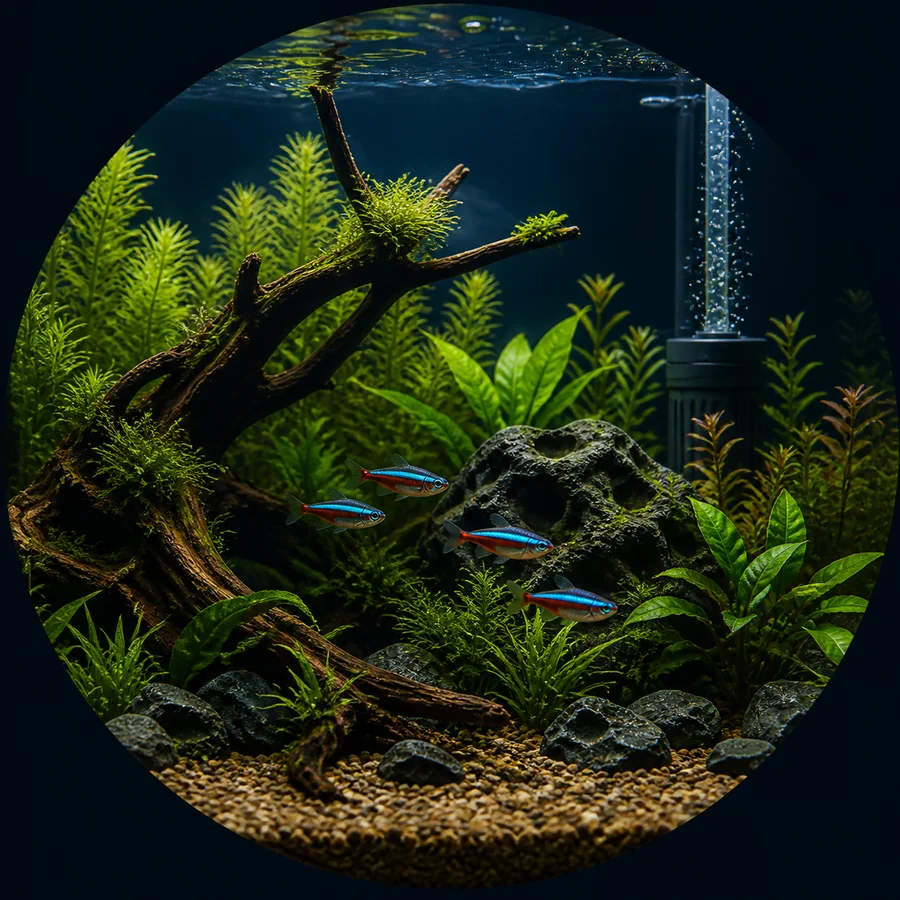
Build a baseline first
You cannot detect a change without knowing what normal looks like for that individual. Normal differs by species, age, sex, time of day, and social context: behaviour that would be alarming in an active daytime schooler may be routine for a nocturnal catfish or a resting wrasse. Watch your animals when they are well, and remember how they look and behave.
Observe before you feed and before you disturb the tank. Feeding changes behaviour immediately and can mask the exact signs you are looking for.
Behavioural changes worth noticing
- Reduced or absent appetite, or approaching food and then refusing it.
- Rapid, laboured, or exaggerated gill movement; gasping at the surface; hanging near an air stone or outflow.
- Scratching, flashing, or rubbing against surfaces.
- Clamped fins held tight against the body.
- Loss of balance, listing, sinking, floating, or difficulty maintaining position.
- Isolation from a group that normally shoals, or unusual hiding in a normally confident animal.
- Sudden aggression, or a previously dominant animal being displaced.
- Shimmying, twitching, spiralling, or other abnormal movement.
Physical changes worth noticing
- Excess mucus, film, or a dulled, cloudy appearance on the skin.
- Spots, patches, lesions, ulcers, or growths — and any change in an existing one.
- Frayed, eroded, reddened, or bloody fin edges.
- Swelling, protruding scales, or a distended abdomen.
- Cloudy, sunken, or protruding eyes.
- Pale, red, swollen, or unevenly moving gills.
- Loss of body condition or a pinched appearance behind the head.
- Changes in faeces, or long trailing pale faeces.
Check the environment before anything else
Water quality is the most frequent underlying cause and the fastest thing to rule out. When something looks wrong, test the relevant parameters, and check temperature, oxygenation, surface agitation, circulation, and every piece of equipment. A stalled powerhead, a failed heater, or a heater stuck on can produce dramatic signs in hours.
Then review recent history: new animals, plants or decor added; a water change; a change in source water; new food; medication or any chemical added; a power interruption; a missed maintenance cycle; household aerosols, paint, or cleaning products used near the tank; and any recent mortality. Fish do not develop symptoms in a vacuum, and this history is what a veterinarian will ask for.
Respond in order
- Confirm the observation and check every animal, not just the most visibly affected one.
- Test water parameters and verify temperature, oxygen, flow, and equipment function.
- Review recent additions, changes, and events.
- Correct any environmental problem you find, at a rate the animals can tolerate.
- Document signs, dates, photographs, and measured values without letting documentation delay urgent action.
- Isolate only where doing so is safe and appropriate for that animal and system.
- Contact qualified aquatic-veterinary help for severe respiratory distress, rapid deterioration, multiple unexplained deaths, neurological signs, major injury, or any situation you cannot explain.
Why not to reach for medication first
Treating without a diagnosis is a genuine risk, not just wasted money. Many aquarium treatments are toxic to invertebrates, plants, or particular fish families; some damage the biological filter and create a water-quality crisis on top of the original problem; and combining products can produce interactions the labels do not describe. Dosing is calculated on the actual water volume — not the tank's nominal size, which substrate and decor reduce.
If a treatment is indicated, follow the current product label for that exact product, respect its contraindications, and prefer direction from a professional who has examined the animal. Fishician's tools help you organise volume, labels, and history; they do not prescribe.
Sources and further reading
Each source is listed with the part of this guide it supports. Source scope matters: a taxonomy record, product label, or general husbandry page does not automatically support every care claim.
- Merck Veterinary Manual: Disorders and Diseases of Fish
Categories of fish disease, the role of environment and stress, and why visible signs are rarely specific to one cause. - Merck Veterinary Manual: Routine Health Care of Fish
Observation, early detection, quarantine, and when professional diagnosis is required. - University of Florida IFAS: Common Freshwater Fish Parasites Pictorial Guide — Sessile Ciliates
Why parasite identification requires microscopy rather than visual inspection of the whole animal. - University of Florida IFAS: Cryptocaryon irritans (Marine White Spot Disease) in Fish
Marine white-spot life cycle, why visible spots represent only one stage, and diagnostic confirmation.