

 Fishician®
How to read a fish food label
Fish food gets picked from the front of the pack. The useful information is on the label, along with what it can't tell you.
About this guide
On this page
The short answer
- Start with your fish. Write down what each species eats and where it feeds before comparing tubs.
- Ingredients are in weight order. The first few matter most. Ingredient names alone do not establish digestibility or nutritional suitability.
- The analysis is a range. "Crude" is the lab method, not quality, and the numbers are minimums or maximums.
- Size and sinking decide who eats. Often more useful than the protein percentage.
- Use ordinary feeding directions as a starting point. Adjust ordinary portions to the species and observed intake; follow medicated-food directions exactly.

Reading a label in three passes
Read first
- First few ingredients
- Pellet or particle size
- Floats or sinks
- Manufacture or expiry date
Compare carefully
- Only similar formats
- Frozen and gel foods hold far more water
- Or convert to dry-matter basis
Adjust from
- Who actually gets food
- Body condition
- Leftovers
- Water test results
Match food to feeding style
- A mixed tank usually needs more than one food.
- Choose food each fish can reach and eat; remove uneaten pellets before they break down.
- Too-large food goes uneaten; too-fine food drifts into the filter.
- For a carnivore, a grain or filler as the first ingredient deserves a closer look.
Digestibility matters
- Two foods with similar numbers can digest differently.
- What isn't digested becomes waste your filter has to handle. See feeding and nutrition.
Storage and special foods
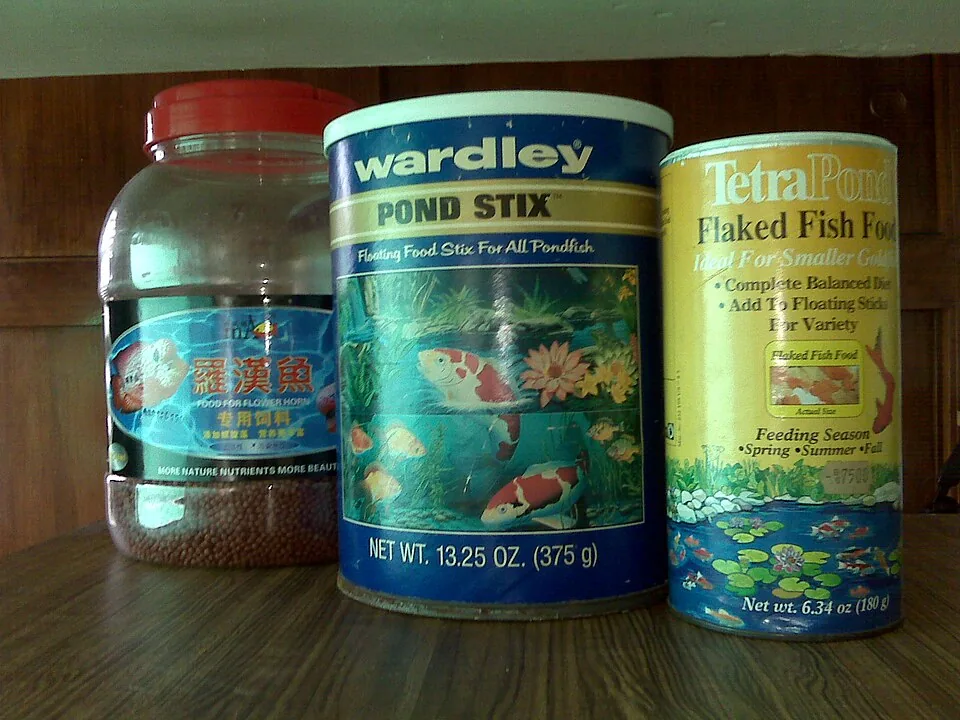
- Heat, light, moisture and time degrade nutrients. A tub stored above a lit tank isn't the food on the label.
- Buy a size you'll finish, keep it sealed and cool, and keep wet fingers and scoops out.
- Medicated or supplemented foods: follow the exact amounts and duration on the label.
Guaranteed analysis terms
- Crude protein, fat, fibre, moisture and sometimes ash, stated as minimums or maximums.
- They tell you the food's broad category, not whether a species will thrive on it.
- Frozen and gel foods carry much more water, so compare them only after converting to a dry-matter basis.
- Feeding directions can't know your stocking, temperature or life stages. Use them as a starting reference.
Sources
Each source is listed with the part of this guide it supports.
- University of Florida IFAS: Fish NutritionNutrient requirements, protein and energy in fish diets, and how species and life stage change dietary needs.
- University of Florida IFAS: The Benefits of Fishmeal in Aquaculture DietsIngredient quality, palatability, and why formulated diets differ in digestibility and nutrient availability.
- Merck Veterinary Manual: Management of Aquarium FishFeeding practice, overfeeding as a water-quality failure, and uneaten-food removal.